
How to Choose the Right FUE Punch Size in 2026: 0.8mm vs 0.9mm vs 1.0mm
Written by: Akhzar Instruments Team
Content Note: This article is an educational resource about FUE instruments and punch selection. It is based on professional hair-restoration resources and published clinical literature. It is not a substitute for clinical training or professional medical advice.
Quick Answer: What Is the Best FUE Punch Size?
There is no single best FUE punch size for every patient or every follicular unit.
The commonly used 0.8mm, 0.9mm and 1.0mm options each have different characteristics:
- 0.8mm FUE punch: A smaller-diameter option that may be suitable for appropriately sized follicular units.
- 0.9mm FUE punch: A versatile mid-range option commonly used in scalp FUE.
- 1.0mm FUE punch: A larger option that may be considered when additional clearance is appropriate.
The International Society of Hair Restoration Surgery (ISHRS) reports that FUE micro-punches are available in a range of sizes and that punch selection is part of the instrumentation used for follicular unit excision.
The appropriate punch size depends on the follicular unit, hair characteristics, donor-area anatomy, punch design and the surgeon’s technique.
What Is an FUE Punch?
An FUE punch is a small hollow surgical instrument used to make a circular incision around an individual follicular unit during follicular unit excision.
After the follicular unit has been separated from surrounding tissue, it can be extracted for preparation and transplantation.
FUE punches are available in different diameters and designs, including manual and powered configurations. The ISHRS FUE Instruments and Their Use explains that manual FUE punches are circular hollow instruments and discusses the development of different punch designs.
For clinics and professional buyers, choosing the right [INTERNAL LINK → FUE Punches] also involves considering punch diameter, design, manufacturing consistency and intended application.
Why Does FUE Punch Size Matter?
Punch diameter determines the size of the initial circular incision around the follicular unit.
A punch that is too small for a particular graft may provide insufficient clearance, while an unnecessarily large punch may remove more tissue than required.
The objective is therefore not simply to use the smallest available instrument.
Instead, the goal is to select an appropriately sized punch that provides suitable clearance for the graft while supporting controlled extraction.
Published research has evaluated differences in wound dimensions and tissue loss between different FUE punch designs. PubMed: Comparison of tissue loss by different punches
0.8mm FUE Punch
A 0.8mm FUE punch is toward the smaller end of the commonly discussed scalp FUE punch range.
It may be considered when the target follicular unit is appropriately sized for a smaller-diameter instrument and the surgeon’s technique supports its use.
Potential Advantages
- Smaller punch diameter
- Suitable for appropriately sized follicular units
- Can support precise extraction
- Smaller initial diameter compared with larger punch sizes
- Useful as part of a multi-size FUE instrument selection
However, 0.8mm is not automatically better than 0.9mm or 1.0mm.
The follicular unit, hair caliber, follicular direction and donor characteristics still need to be considered.
0.9mm FUE Punch
The 0.9mm FUE punch sits between 0.8mm and 1.0mm and is a commonly encountered size in scalp FUE.
A published clinical study specifically evaluated the use of a 0.9mm serrated punch and found that transection rates varied between different scalp regions.
PubMed: Transection rate at different areas of scalp during FUE
Why Is 0.9mm Commonly Considered?
It can provide a practical middle option between:
- Punch diameter
- Graft clearance
- Extraction control
- Tissue removal
- Different follicular-unit configurations
However, 0.9mm should not be treated as a universal “best” size.
1.0mm FUE Punch
A 1.0mm FUE punch provides more internal diameter than 0.8mm and 0.9mm options.
This additional clearance may be considered when the surgeon determines that a larger punch is appropriate for a particular follicular unit.
Potential Considerations
- Wider follicular units
- Multi-hair grafts
- Particular graft anatomy
- Need for additional clearance
- Specific donor-area characteristics
A larger punch is not automatically superior. The amount of tissue removed and the characteristics of the individual graft should also be considered.
0.8mm vs 0.9mm vs 1.0mm FUE Punch
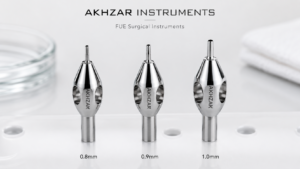
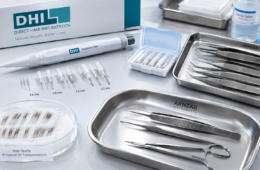
Akhzar Instruments FUE surgical instruments showing different punch sizes for professional hair transplant procedures.
| Punch Size | General Position | Potential Application | Main Consideration |
|---|---|---|---|
| 0.8mm | Smaller | Appropriately sized follicular units | Adequate clearance |
| 0.9mm | Mid-range | Versatile scalp FUE option | Graft-specific selection |
| 1.0mm | Larger | Wider or challenging grafts | Avoid unnecessary tissue removal |
This is a general educational comparison, not a clinical prescription.
Is a Smaller FUE Punch Always Better?
No.
A smaller punch diameter can mean a smaller initial opening, but the instrument still needs to provide appropriate clearance around the follicular unit.
If the punch is inappropriate for the graft anatomy, extraction may become more technically difficult.
At the same time, using a larger punch than necessary may increase the amount of tissue removed.
The discusses the development of smaller punch diameters and their role in reducing the size of circular extraction scars.
The key principle is:
The best punch is not necessarily the smallest punch. It is the appropriately selected punch.
What Factors Affect FUE Punch Selection?
Hair Caliber
Hair thickness can influence the characteristics of the follicular unit being harvested.
Number of Hairs Per Graft
Single- and multi-hair follicular units may have different configurations.
Follicular Curvature
Follicles can curve beneath the skin, making extraction direction an important consideration.
Hair Exit Angle
The visible direction of a hair does not necessarily represent the complete direction of the follicle below the skin.
Donor-Area Characteristics
Donor density and anatomical characteristics can affect extraction.
A study using a 0.9mm serrated punch found differences in transection between scalp regions, highlighting the importance of donor-area characteristics. [OUTBOUND LINK → PubMed clinical study]
Sharp vs Serrated FUE Punch
Punch diameter is only one part of instrument selection.
The cutting-edge design also matters.
Sharp FUE Punch
A sharp punch has a cutting edge designed to penetrate tissue.
Its performance depends on factors such as geometry, sharpness, alignment and extraction technique.
Serrated FUE Punch
A serrated punch uses a serrated cutting edge and is widely used in FUE procedures.
A comparative study evaluated sharp, serrated and blunt punches using the same 0.9mm size and investigated differences in transection rates.
This means that two FUE punches with the same diameter are not necessarily identical in design or performance.
Does Punch Size Affect Transection?
Punch size can influence extraction, but it is only one factor.
Other considerations include:
- Follicular angle
- Follicular curvature
- Donor-area anatomy
- Graft size
- Hair characteristics
- Punch design
- Punch alignment
- Extraction depth
- Surgical technique
- Operator experience
Research has shown that punch design, hair characteristics and donor-area factors can influence FUE extraction outcomes.
PubMed: An Analysis of Follicular Punches, Mechanics and Dynamics in FUE
Therefore, neither “smaller is always better” nor “larger always prevents transection” is an appropriate general rule.
How Should Clinics Choose an FUE Punch Size?
A practical approach is to begin with the follicular unit rather than the instrument.
Assess the Graft
Consider graft size, configuration and number of hairs.
Assess Hair Direction
Consider the visible hair direction and expected follicular direction.
Evaluate the Donor Area
Donor density and anatomical characteristics should be considered.
Select the Appropriate Diameter
Choose a punch that provides suitable clearance for the target follicular unit.
Consider Punch Design
Sharp and serrated configurations can have different characteristics.
Maintain Multiple Sizes
Clinics may benefit from having multiple options such as 0.8mm, 0.9mm and 1.0mm, depending on their procedures and surgeon preferences.
For professional buyers, Akhzar Instruments offers a range of hair transplant instruments for clinics, distributors and international B2B buyers.
What Should You Look for in a Quality FUE Punch?
For professional buyers, the diameter printed on an instrument is only one consideration.
Manufacturing Consistency
Consistent dimensions are important when instruments are purchased repeatedly.
Cutting-Edge Quality
The cutting edge should be manufactured consistently for its intended application.
Material and Finish
Material quality and surface finish are important considerations for professional surgical instruments.
Batch Consistency
Clinics and distributors ordering multiple instruments should consider consistency across production batches.
Supplier Support
International buyers may also need reliable communication, packaging, customization and export support.
Choosing an FUE Punch Manufacturer
For clinics, distributors and medical suppliers, choosing an FUE punch manufacturer involves more than comparing prices.
Professional buyers may require:
- Multiple punch diameters
- Sharp and serrated options
- Bulk supply
- OEM manufacturing
- Private-label production
- Custom packaging
- Export support
- Consistent production
A manufacturer with experience in hair transplant instruments can help B2B buyers source different instrument configurations according to their requirements.
FUE Punches from Akhzar Instruments
Akhzar Instruments is a Sialkot, Pakistan-based manufacturer and exporter of hair-transplant and surgical instruments for international B2B buyers.
Its hair-restoration instrument range includes:
- FUE Punches
- Sapphire Blades
- DHI Implanter Pens
- Hair Transplant Forceps
- Scissors
- Graft Handling Instruments
Akhzar Instruments focuses on supplying hair-transplant instruments to clinics, distributors, importers and private-label businesses.
Buyers looking for FUE punches wholesale, an FUE punch supplier, or OEM/private-label hair transplant instruments can contact Akhzar Instruments to discuss available specifications and requirements.
0.8mm, 0.9mm or 1.0mm: Which One Should You Choose?
The answer depends on the individual graft.
0.8mm may be appropriate when a smaller diameter provides sufficient clearance.
0.9mm can provide a useful middle option and is widely represented in FUE practice.
1.0mm may be considered when additional clearance is appropriate for a particular follicular unit.
The final decision should be made by the qualified professional performing the procedure based on the patient’s anatomy and the surgical technique.
Frequently Asked Questions
What is the best FUE punch size?
There is no universal best size. The appropriate punch depends on the follicular unit, donor characteristics, punch design and surgical technique.
What FUE punch size is commonly used?
FUE punches are available in a range of sizes. ISHRS currently describes micro-punches ranging from approximately 0.7mm to 1.2mm, depending on the instrument and application.
Is a 0.8mm FUE punch better than 0.9mm?
Not necessarily. A smaller diameter does not automatically make an instrument more appropriate. Graft anatomy and surgical technique are important.
Is 0.9mm better than 1.0mm for FUE?
Neither is universally better. A 0.9mm punch provides a smaller diameter, while a 1.0mm punch provides additional clearance.
What is a 1.0mm FUE punch used for?
It may be considered when additional clearance is appropriate for a particular follicular unit.
Does FUE punch size affect transection?
It can, but transection is also influenced by follicular direction, donor anatomy, punch design and surgical technique.
What is the difference between a sharp and serrated FUE punch?
The main difference is the cutting-edge design. Studies comparing punch designs have reported differences in transection.
Does a larger punch create a larger extraction site?
Punch diameter can affect the initial extraction opening, although wound characteristics also depend on punch design and technique.
Should a clinic stock multiple FUE punch sizes?
Having multiple sizes can provide flexibility when graft characteristics vary. The appropriate inventory depends on the clinic and surgeon.
Are serrated punches used in professional FUE?
Yes. Serrated punches are used in FUE and have been evaluated in clinical research. Their suitability depends on the instrument and the surgeon’s technique.
Where can clinics buy FUE punches?
Clinics can source FUE punches from specialized surgical-instrument manufacturers and suppliers. Buyers should evaluate specifications, manufacturing consistency, quality requirements and B2B support.
For B2B requirements, see Akhzar FUE Punches.
Does Akhzar Instruments supply FUE punches for B2B buyers?
Akhzar Instruments manufactures and exports hair-transplant and surgical instruments for professional and international B2B buyers.
Final Takeaway
Choosing an FUE punch is a balance between graft anatomy, punch diameter, punch design, donor-area characteristics and surgical technique.
The 0.8mm, 0.9mm and 1.0mm options each have a place in professional FUE instrument selection. Rather than assuming that the smallest or largest punch is automatically best, the appropriate instrument should be selected according to the individual follicular unit and the technique being used.
For clinics, distributors and international buyers, manufacturing consistency and supplier reliability are also important.
Akhzar Instruments supplies and other hair-transplant instruments for professional and international B2B buyers.
1 Comment
Manual vs Motorized FUE Punch: Key Differences
[…] How FUE Punch Design Affects Graft Extraction […]