Introduction
Manual vs motorized FUE punch is an important consideration for hair restoration professionals, clinics and instrument buyers evaluating different FUE extraction systems. FUE hair transplantation uses specialized instruments to extract individual follicular units from the donor area. One important distinction in FUE equipment is the difference between manual punch systems and motorized punch systems. Understanding this difference can help practitioners, clinics, students and instrument buyers evaluate the equipment that fits their professional workflow.
At Akhzar Instruments, our goal is to combine professional hair transplant instrument manufacturing with educational resources that help the hair restoration community understand its tools.
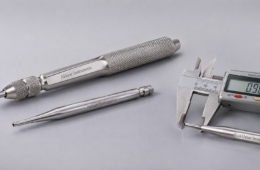
What Is a Manual FUE Punch?
A manual FUE punch is controlled directly by the practitioner.
The operator positions the punch around the selected follicular unit and performs the required movement manually.
Manual systems provide direct control over:
- Position
- Direction
- Movement
- Pressure
- Depth
- Extraction sequence
Manual FUE is therefore closely connected to practitioner experience and technique.
What Is a Motorized FUE Punch?
Difference between manual vs motorized FUE punch, A motorized FUE punch is used with a powered handpiece or driver.
The system assists punch movement depending on its design.
Motorized systems may use:
- Rotation
- Oscillation
- Controlled powered movement
The exact mechanism depends on the equipment.
Technical literature describes both manual and mechanical approaches to FUE extraction.
Manual vs Motorized FUE Punch: Key Differences
When comparing a manual vs motorized FUE punch, the main differences relate to how the punch is moved and controlled during extraction. Manual systems rely on direct operator movement, while motorized systems use a powered handpiece to assist the punch;
| Feature | Manual FUE | Motorized FUE |
|---|---|---|
| Punch movement | Manually controlled | Motor-assisted |
| Operator input | Direct | Through powered handpiece |
| Equipment | Simpler configuration | Requires motorized equipment |
| Technique | Strongly operator-dependent | Requires device-specific training |
| Control | Direct tactile control | Powered movement control |
| Compatibility | Manual holder/system | Compatible motorized system |
Neither approach is automatically superior for every clinic.
punch designs and motorized devices → PubMed review
Benefits of Manual FUE Punch Systems
Direct control
The practitioner directly controls punch movement.
Simple configuration
Manual systems can involve fewer mechanical components.
Tactile feedback
Some practitioners prefer direct physical feedback during extraction.
Flexibility
Manual systems can be useful for practitioners who prefer direct control over individual movements.
Benefits of Motorized FUE Punch Systems
Powered movement
The motor assists punch movement.
Workflow considerations
Motorized systems may be useful when evaluating procedure workflow and volume.
Controlled movement
Depending on the system, powered movement can provide a consistent operating mechanism.
Different operating modes
Some systems offer different rotation or oscillation settings.
Motorized equipment nevertheless requires proper training.
micromotor-assisted FUE → PubMed research
Is Motorized FUE Better?
Between manual vs motorized FUE punch, Not automatically.
Motorized equipment does not remove the importance of:
- Follicular anatomy
- Hair direction
- Punch diameter
- Punch design
- Alignment
- Depth
- Operator skill
Technology can assist movement, but it does not replace professional knowledge.
manual and motorized FUE techniques → PMC research
Is Manual FUE Outdated?
No.
Manual FUE remains an established extraction approach.
The choice between manual and motorized systems can depend on:
- Practitioner experience
- Procedure requirements
- Workflow
- Equipment availability
- Training
- Instrument compatibility
- Budget
The most technologically advanced system is not automatically the most suitable system for every professional.
manual and powered FUE devices → ISHRS source
Punch Diameter Still Matters
Changing from manual vs motorized FUE punch extraction does not remove the need to understand punch diameter.
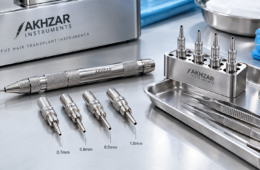
Common FUE punch sizes include:
0.7 mm | 0.8 mm | 0.9 mm | 1.0 mm
The appropriate size depends on the follicular unit, donor area and extraction approach.
Read:
How FUE Punch Design Affects Graft Extraction
Sharp and Serrated Punches
Punch design is another important consideration.
Sharp punches generally have a smooth cutting edge, while serrated punches contain small serrations.
Depending on the system, different punch designs may be available for manual or motorized applications.
Read:
How Should a Clinic Choose?
A clinic can evaluate:
Practitioner experience
Does the practitioner have appropriate training with the system?
Procedure requirements
Does the workflow favor manual or powered movement?
Equipment compatibility
Are the selected punches compatible with the handpiece?
Training
Can the clinical team receive appropriate training?
Maintenance
What maintenance and replacement requirements exist?
Budget
What is the total cost of the complete system?
Supply
Can replacement instruments be obtained reliably?
Common Misconceptions
“Motorized FUE eliminates transection.”
It does not.
Graft injury can still be influenced by anatomy, alignment, punch design, depth and technique.
otary and oscillatory punch methods → PubMed study
“Manual FUE is outdated.”
Manual FUE remains an established approach.
“The smallest punch is always best.”
Not necessarily. Punch diameter should be considered according to graft characteristics and technique.
“The most expensive system is automatically better.”
Price alone does not determine suitability.
FUE Punch Selection Checklist
Before selecting a manual vs motorized FUE punch system, consider:
Manual or motorized?
↓
Punch diameter?
↓
Sharp or serrated?
↓
System compatibility?
↓
Operator training?
↓
Instrument quality?
↓
Supply and replacement requirements?
International B2B Instrument Requirements
International clinics and distributors may have requirements beyond the basic instrument.
These can include:
- Wholesale quantities
- OEM/private-label production
- Custom specifications
- Product packaging
- Export support
- Consistent manufacturing
- Long-term supply
Akhzar Instruments works with professional buyers seeking hair transplant instruments for clinics, distributors and international markets.
Akhzar Instruments: Manufacturing + Education
Akhzar Instruments is developing an educational resource around hair transplant instruments alongside its manufacturing and B2B supply activities.
Our educational topics include:
- FUE punch systems
- Manual and motorized extraction
- Punch diameter
- Sharp and serrated designs
- Graft handling
- Forceps
- Sapphire blades
- Implanter instruments
Frequently Asked Questions
What is a manual FUE punch?
A manual FUE punch is directly controlled by the practitioner during graft extraction.
What is a motorized FUE punch?
A motorized FUE punch is used with a powered handpiece or driver that assists punch movement.
Is motorized FUE better than manual FUE?
Not universally. The appropriate system depends on experience, workflow, equipment and technique.
Can sharp punches be used for manual FUE?
Yes, depending on the specific punch design and system.
Can serrated punches be used with motorized systems?
Some serrated punches are designed for compatible motorized systems.
What punch sizes are commonly available?
Common sizes include 0.7 mm, 0.8 mm, 0.9 mm and 1.0 mm.
Does motorized FUE eliminate graft transection?
No. Multiple factors can contribute to transection.
Conclusion
Between manual vs motorized FUE punch Manual and motorized FUE punch systems provide different approaches to follicular unit extraction.
Manual systems provide direct operator control, while motorized systems use powered movement to assist the punch.
The right choice is not simply about selecting the newest technology.
It is about matching:
System + Punch + Anatomy + Technique + Training + Workflow
Akhzar Instruments aims to support the global hair restoration community through professional instrument manufacturing, B2B supply and educational resources.