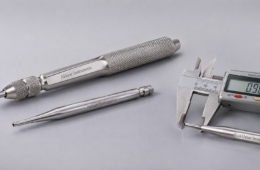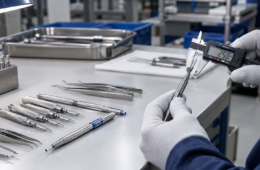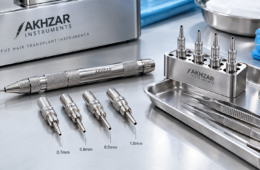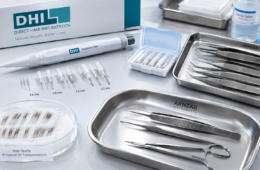
Graft forceps play an important role in handling follicular units during a hair transplant procedure. When they are poorly designed, misaligned, or used with excessive pressure, they may contribute to unnecessary graft manipulation and tissue damage.
If you are noticing crushed grafts, damaged follicular units, excessive tissue handling, or grafts slipping from the forceps, the problem may not always be with the extraction procedure. Your graft forceps and the way they are being used may also be contributing to the problem.
The good news is that many graft-handling problems can be identified by looking at the instrument, handling technique, and overall workflow.
In this guide, we will explain why graft forceps may damage follicular units, what problems to look for, how forceps design affects graft handling, and how clinics can choose more suitable instruments.
Quick Answer: Why Are Graft Forceps Damaging Follicular Units?
Graft forceps can contribute to follicular-unit damage when they apply excessive pressure, have unsuitable or misaligned tips, or are used with unnecessary pulling and repeated manipulation.
Common causes include:
- Excessive squeezing pressure
- Gripping the graft incorrectly
- Misaligned forceps tips
- Rough or damaged working surfaces
- Repeatedly picking up the same graft
- Pulling or stretching grafts unnecessarily
- Poor visibility during graft handling
- Unsuitable forceps design
- Inexperienced handling technique
- Poor graft storage or hydration
The objective should not be to find the strongest forceps. It should be to find an instrument that provides controlled grip with minimum unnecessary pressure.
What Are Graft Forceps?
Graft forceps are fine surgical instruments used to handle individual follicular units during hair transplantation.
Depending on the procedure and workflow, they may be used for:
- Handling extracted grafts
- Moving grafts from a holding solution
- Organizing follicular units
- Positioning grafts
- Loading grafts for implantation
- Adjusting graft orientation
A follicular unit may contain one, two, three, or more hairs. Because of this, graft handling requires more control than simply picking up a small object with ordinary tweezers.
Tip design, alignment, surface finish, spring action, size, and operator technique can all affect how easily a graft can be controlled.
For clinics looking for different types of hair restoration tools, you can explore the range of hair transplant instruments from Akhzar Instruments.
1. Excessive Pressure From the Forceps
One of the most common graft-handling problems is excessive squeezing.
An operator may apply more pressure because the graft is slipping or because the forceps do not provide enough control. However, increasing pressure is not always the correct solution.
The basic principle should be:
Secure grip + minimum necessary pressure.
If a forceps only holds a graft when significant pressure is applied, it may be worth checking the tip design, alignment, and overall suitability of the instrument.
Where Akhzar Instruments Can Help
At Akhzar Instruments, we look at the intended application when discussing graft forceps rather than treating every forceps as the same product.
For clinics experiencing slipping or excessive gripping pressure, factors such as tip profile, dimensions, grip characteristics, and application can be reviewed to help identify a more suitable instrument specification.
The goal is simple: better control without unnecessary squeezing.
2. Gripping the Graft Incorrectly
Another potential cause of graft trauma is holding the follicular unit in an inappropriate position or repeatedly changing the gripping point.
The operator needs enough control to move and position the graft without unnecessary compression or manipulation.
The exact handling method depends on the graft, procedure, and operator’s technique.
Practical Solution
Focus on controlled movements and avoid unnecessary repositioning.
If the instrument does not provide reliable control, inspect the forceps before changing the handling technique completely.
A properly designed graft forceps should make delicate handling easier rather than forcing the operator to compensate with excessive pressure.
3. Misaligned Forceps Tips
Sometimes the problem is the instrument itself.
Forceps tips that do not meet evenly can make graft handling difficult. The operator may compensate by squeezing harder, which can make delicate handling even more difficult.
Check the forceps for:
- Uneven tips
- Bent tips
- Poor closure
- Excessive gap
- Damaged gripping surfaces
- Rough edges
- Tip deformation
A small problem at the working tip can become significant when hundreds or thousands of grafts are handled.
How Akhzar Instruments Can Help
For professional hair-transplant instruments, consistency matters.
Akhzar Instruments focuses on application-specific hair-transplant instruments and can work with buyers on required tip configuration, dimensions, and other specifications.
For clinics ordering multiple forceps, consistent construction is particularly important because operators should not have to adjust their handling technique for every individual instrument.
4. Rough or Damaged Forceps Surfaces
A graft forceps should provide predictable contact with the follicular unit.
If the working surface becomes rough, damaged, or deformed, handling may become less controlled.
This can happen through repeated use, cleaning, sterilization, accidental bending, or general instrument wear.
Practical Solution
Inspect forceps regularly.
If the tips no longer meet correctly or the surface has become damaged, the instrument should be removed from use rather than forcing the operator to compensate.
For clinics that use large numbers of graft-handling instruments, maintaining consistent instrument quality can make the workflow easier to manage.
5. Grafts Keep Slipping From the Forceps
If grafts repeatedly slip, the first reaction may be to squeeze harder.
But before doing that, ask:
- Are the tips aligned?
- Is the tip design appropriate?
- Is the forceps too large or too small?
- Is the instrument damaged?
- Is the graft being held correctly?
- Is the operator repeatedly changing the gripping position?
An Instrument Problem Can Look Like a Technique Problem
This is where selecting the right instrument specification becomes important.
Akhzar Instruments works with clinics, distributors, and international buyers who may require different graft forceps configurations depending on their application.
Instead of simply asking for “graft forceps,” buyers can discuss the required use, tip configuration, quantity, customization, and other specifications.
That helps move the conversation from “Which forceps should I buy?” to “Which forceps is suitable for my actual workflow?”
6. Repeatedly Picking Up the Same Graft
Every unnecessary manipulation creates another opportunity for mechanical trauma.
A graft may be repeatedly picked up because:
- The forceps cannot grip it properly
- The graft orientation is incorrect
- The recipient site is not ready
- Visibility is poor
- The instrument is unsuitable
- The operator is trying to correct the graft position
The more frequently a graft is manipulated, the more important controlled handling becomes.
Practical Solution
Improve the workflow so that grafts can be picked up, positioned, and transferred with fewer unnecessary movements.
If repeated manipulation is caused by poor instrument control, changing the forceps specification may be more useful than simply training the operator to squeeze harder.
7. Pulling Instead of Controlled Handling
Forceps should assist controlled graft handling, not aggressive traction.
If a graft is difficult to remove during extraction, repeatedly pulling harder with forceps may not solve the underlying problem.
The difficulty may instead be related to:
- Incomplete dissection
- Tethering
- Punch depth
- Extraction angle
- Surrounding tissue
- Extraction technique
Important Distinction
If the problem occurs during extraction, review the extraction technique first.
If the graft has already been extracted and the problem occurs during handling or implantation preparation, then the forceps, workflow, and handling technique should also be reviewed.
This distinction helps prevent the wrong instrument from being blamed for a problem occurring elsewhere in the procedure.
8. The Wrong Forceps Design
Not every fine surgical forceps is suitable for every hair-transplant application.
Important design considerations include:
- Tip width
- Tip length
- Tip shape
- Alignment
- Surface finish
- Spring tension
- Overall dimensions
- Operator comfort
A forceps designed for one application may not be ideal for another.
Akhzar’s Problem-Solving Approach
This is one area where instrument customization can be useful.
Akhzar Instruments supplies hair-transplant instruments for clinics, distributors, OEM buyers, and private-label requirements.
Instead of offering only a generic configuration, buyers can discuss their intended application and required specifications.
Depending on the requirement, factors such as tip design, dimensions, finishing, quantity, branding, and packaging can be discussed.
This is particularly useful for buyers who already know the limitations of their current instruments and need something better suited to their workflow.
9. Poor Visibility During Graft Handling
Even a properly manufactured forceps cannot compensate for poor visualization.
When the operator cannot clearly see the follicular unit, unnecessary repositioning and excessive pressure can occur.
Appropriate lighting and magnification can therefore play an important role in controlled graft handling.
Practical Solution
Review the complete working environment:
Instrument + visualization + technique + workflow
All four factors should work together.
If the operator can clearly see the graft but still struggles to control it, then the forceps itself deserves closer inspection.
10. Graft Hydration and Holding Conditions
Mechanical handling is only one part of graft preservation.
Follicular units also need appropriate handling conditions between extraction and implantation.
Research on follicular-unit graft handling has examined factors such as graft injury, storage, and handling conditions. Hair-transplant professionals can explore relevant peer-reviewed literature through PubMed and clinical resources from the International Society of Hair Restoration Surgery (ISHRS).
For additional medical literature on hair restoration and follicular-unit procedures, NCBI provides access to a large collection of peer-reviewed research.
These resources can help professionals better understand the scientific and clinical considerations behind graft handling.
Practical Solution
Review the complete workflow:
Extraction → Collection → Holding → Handling → Implantation
A graft can encounter problems at any of these stages.
The objective should be to minimize unnecessary exposure, manipulation, and delay.
How to Choose the Right Graft Forceps
When selecting graft forceps, price should not be the only consideration.
Look at the following factors.
1. Tip Alignment
The tips should meet correctly and consistently.
Poor alignment can make delicate graft handling unnecessarily difficult.
2. Tip Design
The tip should be appropriate for the intended application.
Different profiles may provide different levels of grip and control.
3. Smooth Movement
The forceps should open and close smoothly.
Excessive resistance can contribute to hand fatigue during longer procedures.
4. Controlled Grip
The instrument should provide enough control without requiring excessive squeezing.
5. Manufacturing Consistency
If a clinic orders multiple instruments, consistency between individual forceps becomes important.
6. Sterilization Compatibility
The instrument should be appropriate for the clinic’s established cleaning and sterilization procedures and should be inspected regularly for wear.
7. Application-Specific Requirements
Ask what the forceps will actually be used for before choosing a configuration.
This is particularly important when ordering instruments for a clinic, distributor, OEM, or private-label business.
Graft Forceps vs Implanter Pens
Forceps and implanter pens are used differently.
With forceps, the graft is directly handled by the instrument.
With an implanter pen, the graft is loaded into the device and inserted into the recipient site.
Neither should automatically be considered “better” in every situation. The appropriate choice depends on the surgeon, technique, graft characteristics, workflow, and operator experience.
The important principle is the same:
Minimize unnecessary graft manipulation.
Akhzar Instruments supplies graft-handling instruments and other hair-transplant tools, allowing clinics and buyers to consider their complete workflow rather than looking at one instrument in isolation.
Graft Forceps Troubleshooting Checklist
| Problem | Possible Cause | What to Check |
|---|---|---|
| Graft slipping | Poor tip contact | Tip alignment and profile |
| Excessive squeezing | Unsuitable grip | Forceps design |
| Repeated repositioning | Poor control | Tip size and handling |
| Bent tips | Instrument wear | Tip condition |
| Difficult extraction | Extraction issue | Dissection and technique |
| Graft deformation | Excessive pressure | Operator grip |
| Frequent manipulation | Workflow issue | Collection and handling process |
| Poor graft condition | Storage issue | Holding conditions |
| Hand fatigue | Spring resistance | Instrument ergonomics |
| Inconsistent performance | Manufacturing variation | Instrument quality |
How Akhzar Instruments Helps Solve Hair-Transplant Instrument Problems
Choosing a hair-transplant instrument should begin with the problem the clinic is trying to solve.
For example:
Grafts slipping?
The tip profile, alignment, grip, and application should be reviewed.
Too much pressure required?
The forceps design and handling characteristics should be evaluated.
Tips becoming damaged or misaligned?
Instrument quality, construction, and replacement requirements should be considered.
Standard forceps don’t fit your workflow?
A customized or application-specific specification may be more appropriate.
Need instruments under your own brand?
OEM and private-label options can be discussed.
Akhzar Instruments works with clinics, distributors, and international buyers looking for hair-transplant instruments including graft forceps, FUE punches, blades, implanter pens, needles, graft-handling instruments, and supporting tools.
The objective is not simply to supply an instrument.
It is to understand the application and help the buyer identify a more suitable instrument solution.
If you have a specific graft-handling problem, you can contact Akhzar Instruments with your application, required quantity, preferred specifications, or customization requirements.
Final Takeaway
When graft forceps appear to be damaging follicular units, do not immediately assume that the problem is only the operator.
Look at the complete picture.
Is the forceps applying too much pressure? Are the tips aligned? Is the design appropriate? Is the graft being manipulated repeatedly? Is extraction causing excessive traction? Are the holding conditions appropriate?
Once the actual cause is identified, the solution becomes much clearer.
Good graft handling depends on the combination of appropriate instruments, controlled technique, proper visualization, suitable workflow, and consistent instrument quality.
For clinics and hair-transplant professionals, the right forceps should make controlled graft handling easier—not create another problem to manage.
If your current graft forceps are causing slipping, excessive pressure, inconsistent grip, or other handling problems, share your requirements with Akhzar Instruments to discuss a suitable hair-transplant instrument solution.
Frequently Asked Questions
1. Can graft forceps damage hair follicles?
Excessive pressure, repeated manipulation, or inappropriate handling can contribute to graft trauma. Proper technique and suitable instrument design are important.
2. What type of forceps is used for hair transplant grafts?
Fine surgical forceps designed for follicular-unit handling are commonly used. The appropriate configuration depends on the procedure and application.
3. Why do grafts slip from forceps?
Possible causes include poor tip alignment, unsuitable tip design, insufficient grip, damaged tips, or handling technique.
4. Should forceps directly grip the bulb?
Unnecessary direct compression of sensitive parts of the follicular unit should be avoided. Grafts should be handled with controlled pressure.
5. Can damaged forceps cause graft-handling problems?
Yes. Bent, rough, or poorly aligned tips can make controlled handling more difficult.
6. How often should graft forceps be inspected?
They should be checked routinely as part of instrument preparation and quality control, especially when used frequently.
7. Are expensive graft forceps always better?
No. Appropriate design, construction, tip alignment, handling characteristics, durability, and suitability for the application are more important than price alone.
8. Can graft forceps cause transection?
Transection is primarily associated with follicular-unit dissection and extraction. However, poor handling can cause other forms of graft trauma, so unnecessary manipulation should be minimized.
9. Why is graft hydration important?
Follicular units should be protected from unnecessary drying and excessive out-of-body exposure. Proper holding conditions are an important part of graft handling.
10. Are graft forceps used during FUE?
Yes. Forceps can be used to assist with handling extracted follicular units, depending on the procedure and workflow.
11. Are graft forceps used during DHI?
Forceps may be used during certain stages of DHI workflows, although implanter pens are commonly used for implantation.
12. Can Akhzar Instruments provide customized graft forceps?
Yes. Akhzar Instruments works with clinics, distributors, OEM buyers, and private-label customers on hair-transplant instrument requirements and specifications.
13. What should I check before buying graft forceps?
Check tip alignment, tip design, spring action, grip, construction, finishing, intended application, and consistency between instruments.
14. What other instruments are used with graft forceps?
A hair-transplant setup may include FUE punches, punch holders, blades, blade holders, implanter pens, needles, graft-handling instruments, and other supporting tools.
15. Can Akhzar Instruments help if I am not sure which forceps I need?
Yes. Instead of selecting a generic forceps, you can explain the procedure, graft-handling problem, required quantity, and preferred specifications so the appropriate instrument configuration can be discussed.