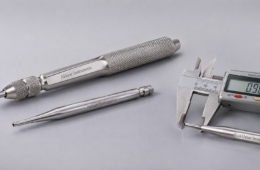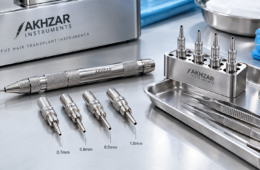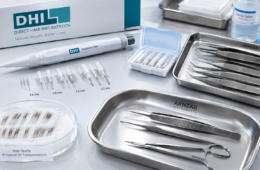
Choosing hair transplant forceps is not simply a matter of finding the smallest or finest pair available.
For clinics and professional buyers, the more important questions are:
What will the forceps be used for? Which tip design is appropriate? How should the graft be handled? And when should forceps be used instead of an implanter?
These questions matter because follicular-unit grafts are delicate structures, and graft placement requires controlled handling.
Forceps have been used in hair transplantation for decades. Implanter devices were later introduced as another method for placing follicular units. Today, both approaches remain part of hair-restoration instrumentation, with the choice depending on the procedure, team, technique, and operator experience.
At Akhzar Instruments, we believe buyers should understand the application first and the instrument second.
This guide explains the main types of hair transplant forceps, how they are used, what problems buyers should watch for, and what to ask a manufacturer before ordering.
Quick Answer: What Are Hair Transplant Forceps Used For?
Hair transplant forceps are fine surgical instruments used to handle, transfer, position, and in some techniques implant follicular-unit grafts.
Forceps may be used during:
- graft handling
- graft sorting
- graft transfer
- recipient-site placement
- hairline work
- graft positioning
- other delicate hair-restoration tasks
The ISHRS describes forceps implantation as gently holding an individual graft and inserting it into a pre-made recipient incision while avoiding damage to the bulb.
Why Are Hair Transplant Forceps Different From General Forceps?
A general surgical forceps may not be designed specifically around the requirements of follicular-unit graft handling.
Hair-transplant forceps commonly require:
- fine working tips
- controlled grip
- suitable alignment
- appropriate spring action
- smooth working surfaces
- dimensions suited to the intended application
The purpose is not simply to grip something tightly.
The operator needs to control a very small graft without unnecessary manipulation.
Historical hair-transplant instrumentation research specifically described cushioned forceps intended to reduce trauma during graft insertion.
Main Types of Hair Transplant Forceps
There is no universal forceps design for every stage.
1. Graft Forceps
Graft forceps are used for handling or transferring follicular-unit grafts during preparation and implantation.
The exact design depends on the clinic’s workflow.
2. Implant Forceps
Implant forceps are designed around placing grafts into recipient sites.
The working tip needs to allow the operator to control the graft and position it appropriately.
3. Fine-Tip Forceps
Fine-tip designs may be selected when the operator needs greater control over individual grafts or delicate work around the hairline.
4. Angled Forceps
An angled design can change the approach of the working tip to the recipient area.
The correct angle depends on operator preference and surgical workflow.
5. Custom Forceps
Professional buyers may require a particular:
- tip configuration
- length
- finish
- engraving
- packaging
- branding
These requirements can be discussed with the manufacturer.
How Are Hair Transplant Forceps Used?
A simplified graft-placement workflow can involve:
Extraction → graft preparation → recipient-site creation → graft placement
During the placement stage, forceps may be used to transfer or insert individual grafts.
The exact process differs between clinics.
The ISHRS notes two main implantation approaches: forceps and implanters. With forceps, the graft is held and inserted into a pre-made incision.
Forceps vs Implanter Pen
This is one of the most common questions buyers and clinics ask.
Forceps
With forceps, the operator directly handles the graft and places it into a prepared recipient site.
Implanter
With an implanter, the graft is loaded into a channel and then pushed into the recipient site using the device.
A review of graft-placement techniques explains that forceps have traditionally been used for graft placement, while implanters were introduced later and offer a different method of handling and inserting follicular units.
The important point is:
There is no need to treat forceps and implanters as competing products where one must always replace the other.
According to the International Society of Hair Restoration Surgery (ISHRS), follicular-unit grafts can be implanted using either forceps or implanters, with each approach having different handling characteristics. Read ISHRS guidance on forceps and implanters
A clinic may use both according to its workflow.
| Factor | Forceps | Implanter |
|---|---|---|
| Direct graft handling | Yes | Reduced |
| Requires pre-made site | Commonly yes | Depends on type |
| Graft loading | No separate device loading | Yes |
| Operator technique | Manual | Device-assisted |
| Common use | Graft handling/placement | Graft implantation |
| Selection | Workflow dependent | Workflow dependent |
Does Using Forceps Damage Hair Grafts?
This is an important question, but it should not be answered with a simple yes or no.
Improper forceps handling can cause unnecessary graft trauma.
ISHRS educational material notes that forceps placement requires good manual dexterity and warns that grasping the graft incorrectly can contribute to trauma. It also discusses approaches intended to reduce direct contact with the follicular structures.
This is why forceps design and operator technique should be considered together.
A good instrument does not replace proper training.
What Part of the Graft Should Be Handled?
Graft handling should follow the clinic’s established surgical protocol and training.
ISHRS educational material specifically discusses avoiding unnecessary grasping around sensitive follicular structures and describes “no-touch” approaches intended to reduce manipulation.
For instrument buyers, the practical lesson is:
Do not choose forceps only by appearance.
The tip should be appropriate for the way the surgical team actually handles grafts.
What Makes Good Hair Transplant Forceps?
1. Tip Alignment
The tips should meet appropriately and consistently.
Poor alignment can make small grafts difficult to control.
2. Tip Design
The correct tip depends on whether the forceps are intended for:
- graft transfer
- implantation
- hairline work
- general handling
3. Controlled Grip
The forceps should provide enough grip for controlled handling without encouraging excessive pressure.
4. Smooth Working Surface
A suitable finish helps support professional use and cleaning.
5. Appropriate Spring Action
The operator should be able to repeatedly open and close the instrument comfortably.
6. Manufacturing Consistency
For a clinic ordering multiple units, consistency between instruments is important.
How Do I Choose the Right Hair Transplant Forceps?
Use this practical process to find supplier like Akhzar Instruments..
Step 1: Define the Job
Ask:
What exactly will this forceps be used for?
Do not start with a catalogue photograph.
Step 2: Define the Tip
Specify the desired tip configuration and dimensions.
Step 3: Define the Length
The working length should suit the operator and application.
Step 4: Define the Grip
The instrument should feel controllable during repetitive work.
Step 5: Check Alignment
If possible, inspect sample instruments for tip alignment.
Step 6: Check Finish
Look for visible irregularities, rough surfaces, or defects.
Step 7: Test a Sample
If you are changing suppliers, test the instrument before ordering a large batch.
Forceps for Hairline Work
Hairline work can require careful positioning because grafts may need to follow planned direction and angulation.
The instrument does not create the aesthetic design by itself.
The surgeon establishes the hairline and implantation strategy; the forceps are simply one of the tools used to execute the plan.
ISHRS guidance emphasizes that recipient-site incision and surgical decisions are clinical responsibilities governed by the relevant qualifications and laws
Forceps have been used for follicular-unit placement for decades, while implanter systems later introduced another approach to graft placement. The choice depends on the technique and the advantages and limitations of each instrument. Read the PubMed review on graft placement techniques.
Forceps and Graft Direction
Graft direction is another common concern.
The ISHRS explains that implanted follicular units should follow the direction and angle of the surrounding hair as closely as possible.
This means forceps selection should be considered together with the clinic’s implantation technique.
An instrument may provide good control, but the final orientation depends on the surgical team’s technique.
Specialized forceps have also been developed as part of the evolution of hair-transplant instrumentation, including designs intended to improve graft handling during insertion. Read the PubMed research on hair-transplant instrumentation
What If Forceps Tips Are Misaligned?
Misaligned tips can make it difficult to control a small graft.
Potential practical problems include:
- inconsistent grip
- difficulty positioning grafts
- increased manipulation
- operator frustration
- inconsistent handling between instruments
For this reason, tip alignment should be part of sample inspection.
If a distributor is purchasing a large quantity, it is particularly useful to compare several units from the same batch.
Should Forceps Be Fine or Wide?
There is no universal answer.
The appropriate tip width depends on the intended graft and application.
A very fine tip may provide useful control for certain tasks, while another application may require a different geometry.
The right question is:
What tip specification does the surgeon already use successfully?
That information is more valuable than simply asking for the “finest” forceps.
Can One Forceps Be Used for Everything?
It can be possible in some workflows, but clinics often use multiple instrument designs for different tasks.
For example:
- one forceps for graft handling
- another for implantation
- another design for specific hairline work
The number and type of forceps should therefore be based on the clinic’s procedure rather than a generic kit.
Forceps vs DHI
Another common confusion is treating forceps and DHI as two different hair-transplant procedures.
They are not directly equivalent.
Forceps are an instrument used for graft handling or implantation.
DHI is commonly used to describe an implantation approach involving an implanter.
The ISHRS specifically states that DHI is not a separate hair-transplant method and discusses forceps and implanters as implantation approaches.
This distinction is useful when ordering instruments.
Instead of asking a supplier for:
“DHI instruments”
it is better to specify:
“Choi/DHI implanter pens + needles + required forceps + other instruments.”
That makes the requirement much clearer.
What Should Clinics Check in a Forceps Sample?
When we recommend sample evaluation, these are the practical points worth checking:
Tip alignment
Do both tips meet evenly?
Tip finish
Is the working surface smooth and free of obvious defects?
Grip
Can the operator control the graft without excessive pressure?
Spring action
Is the opening and closing movement consistent?
Length
Is it comfortable for the intended workflow?
Batch consistency
If you receive multiple samples, are they substantially consistent?
These checks can reveal issues that product photographs cannot show.
Common Problems When Buying Hair Transplant Forceps
Buying Only by Price
A lower unit price does not tell you whether the tip, finish, alignment, or consistency matches your requirement.
Buying Without a Sample
A sample can be particularly useful when changing suppliers.
Not Specifying the Tip
“Hair transplant forceps” is a broad product description.
Ignoring Repeat Supply
Distributors need to know whether the same specification can be reproduced for future orders.
Treating Forceps as a Substitute for Technique
The instrument supports the workflow; it does not replace operator skill.
How Should Hair Transplant Forceps Be Maintained?
Always follow the manufacturer’s instructions like Akhzar Instruments and the clinic’s validated cleaning, sterilization, and reprocessing procedures.
Professional users should also inspect:
- tips
- alignment
- surface condition
- spring action
- signs of damage
Damaged or misaligned instruments should be evaluated according to the clinic’s instrument-management procedures before further use.
What Should I Ask a Hair Transplant Forceps Manufacturer?
Before ordering, send a clear requirement to Ahzar Instruments.
For example:
We require hair transplant forceps for graft handling and implantation. Please provide available tip designs, dimensions, lengths, material/finish, sample availability, MOQ, packaging, and OEM/private-label options.
You can also attach:
- a photograph
- an existing sample specification
- a product reference
- your required quantity
This makes the quotation process much faster.
OEM and Private-Label Hair Transplant Forceps
Professional distributors and medical-instrument companies may require their own brand identity.
Depending on the production arrangement, this may include:
- logo engraving
- custom packaging
- product labels
- product codes
- selected specifications
- bulk quantities
OEM/private-label requirements should be finalized before production begins.
How Akhzar Instruments Can Help
Akhzar Instruments manufactures and exports hair-transplant instruments from Sialkot, Pakistan.
Our range includes:
- Hair transplant forceps
- Implant forceps
- Graft-handling instruments
- FUE punches
- Sapphire and hair-transplant blades
- Implanter pens
- Related instruments and accessories
We work with clinics, distributors, and professional buyers who may require specific products rather than a standard package.
If you already know the forceps design or have a reference sample/photo, you can share the requirement with us.
We can review the product requirement and prepare a quotation based on the requested specification and quantity.
Frequently Asked Questions
1. What are hair transplant forceps used for?
Hair transplant forceps are used to handle, transfer, position, and in some techniques implant follicular-unit grafts during hair-restoration procedures.
2. What is the difference between graft forceps and implant forceps?
Graft forceps are generally intended for graft handling or transfer, while implant forceps are designed around graft placement. Exact designs vary between manufacturers.
3. Are forceps used in FUE?
Yes. FUE describes the extraction method, while forceps may be used afterward for graft handling or implantation.
4. Do forceps damage hair grafts?
Improper handling can cause unnecessary trauma. Technique, graft handling, and the forceps design all matter. ISHRS educational material specifically discusses minimizing trauma during forceps placement.
5. Are forceps better than an implanter pen?
There is no universal answer. Both are established approaches, and the appropriate choice depends on the surgical workflow, graft characteristics, operator experience, and technique.
6. What type of forceps is best for hair transplant?
The appropriate type depends on the intended application. Buyers should specify the required tip design, dimensions, length, and use rather than selecting a product simply because it is labelled “hair transplant forceps.”
7. What should hair transplant forceps tips look like?
The tips should be appropriately aligned, finished, and designed for the intended graft-handling or implantation task.
8. Can one pair of forceps be used for all grafts?
Some workflows may use one design for multiple tasks, while other clinics use different forceps for graft handling, implantation, or specialized work.
9. What size hair transplant forceps should I buy?
There is no universal size. The required dimensions should be based on the surgeon’s established workflow and the intended application.
10. Can I buy hair transplant forceps wholesale?
Yes. Manufacturers and exporters can supply professional quantities for clinics, distributors, and medical-instrument businesses.
11. Can hair transplant forceps be OEM/private label?
Depending on the manufacturer, OEM/private-label options may include engraving, branding, packaging, and agreed product specifications.
12. Should I test a sample before placing a bulk order?
For a new supplier, sample testing is a practical way to evaluate tip alignment, finish, grip, dimensions, and suitability before committing to a larger quantity.
13. What should I send to a forceps manufacturer for a quotation?
Send the intended application, tip design, dimensions if known, quantity, packaging requirement, branding requirement, and a reference photograph or sample if available.
14. Can Akhzar Instruments supply hair transplant forceps internationally?
Yes. Akhzar Instruments manufactures and exports hair-transplant instruments from Pakistan and can review international requirements based on the buyer’s product specification or list.
Final Takeaway
The right hair transplant forceps are not necessarily the smallest, most expensive, or most heavily marketed.
They are the ones that match the intended application and allow the trained surgical team to handle grafts in a controlled and consistent way.
When purchasing forceps, focus on:
tip design → alignment → dimensions → grip → finish → sample testing → batch consistency → repeat supply.
For clinics and distributors, specifying these details before ordering can make the difference between receiving a generic instrument and receiving a product that actually fits the intended workflow.
If you have an existing forceps sample, photograph, specification, or product list, share it with Akhzar Instruments and we can work from that requirement when preparing a quotation.