
Introduction
The FUE punch is one of the key instruments used during follicular unit extraction.
Although it is a small instrument, its diameter, cutting edge, geometry and overall design can affect how it interacts with tissue during graft extraction.
Understanding FUE punch design is useful for hair restoration professionals, clinics, students, distributors and buyers researching hair transplant instruments.
At Akhzar Instruments, we combine instrument manufacturing with educational content to help professionals understand the tools used in hair restoration.
What Is FUE Punch Design?
FUE punch design refers to the physical characteristics of the punch that influence its interaction with tissue around a follicular unit.
Design characteristics can include:
- Punch diameter
- Cutting-edge geometry
- Sharpness
- Serration
- Internal diameter
- Wall thickness
- Surface finish
- Length
- Manual or motorized compatibility
Different designs can produce different interactions with tissue.
Research literature has examined the technical characteristics of FUE punches and mechanical extraction systems.
Why Does FUE Punch Design Matter?
Follicular units are not identical.
They can vary in:
- Number of hairs
- Diameter
- Angle
- Curvature
- Depth
- Orientation
- Surrounding tissue
Because of this variation, punch selection should be considered together with the characteristics of the follicular unit.
Punch Diameter
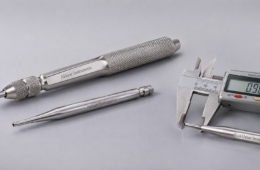
Punch diameter is one of the most obvious differences between FUE instruments.
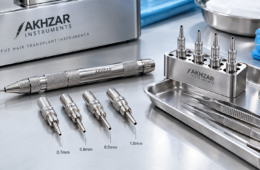
Common sizes include:
- 0.7 mm
- 0.8 mm
- 0.9 mm
- 1.0 mm
The appropriate diameter is not simply the smallest possible diameter.
Professionals need to consider the follicular unit and the extraction technique.
Cutting Edge Design
The cutting edge is another important part of FUE punch design.
A punch may have:
- Sharp edge
- Serrated edge
- Blunt component
- Hybrid configuration
These designs can change the way the instrument interacts with tissue.
For a detailed comparison, read:
Punch Alignment
Punch alignment is closely related to follicular orientation.
Hair follicles can travel at different angles beneath the skin.
A review of FUE technical considerations discusses factors including direction of insertion, orientation and punch characteristics in relation to graft injury and transection.
This leads to an important principle:
A well-designed punch cannot replace appropriate professional technique.
Punch Depth
Depth control is another consideration during extraction.
The practitioner needs to separate the follicular unit while avoiding unnecessary penetration.
Insufficient penetration may not adequately release the graft, while excessive penetration can potentially increase tissue injury.
Professional training and knowledge of follicular anatomy are therefore essential.
Can Punch Design Affect Transection?
Punch characteristics can be one factor associated with transection.
Comparative research has reported different transection results between punch designs under specific study conditions.
However, punch design is not the only factor.
Transection can also be influenced by:
- Follicular curvature
- Hair angle
- Donor area
- Punch diameter
- Alignment
- Depth
- Operator experience
Manual vs Motorized Punch Design
FUE punches can be used in manual or motorized extraction systems.
Manual systems rely on direct operator manipulation.
Motorized systems use a powered driver or handpiece to assist punch movement.
How Should Professionals Evaluate Punch Design?
A practical evaluation framework is:
1. Diameter
Is the diameter appropriate for the intended application?
2. Cutting edge
Is the design sharp, serrated or another configuration?
3. Alignment
Does it suit the intended extraction technique?
4. Compatibility
Is it designed for manual or motorized use?
5. Manufacturing consistency
Are the dimensions and edge characteristics consistent?
6. Intended application
Is the punch appropriate for the extraction workflow?
Common Punch Selection Mistakes
Focusing only on sharpness
Sharpness is important, but it is not the only characteristic.
Selecting diameter without considering grafts
Punch size should be considered alongside follicular characteristics.
Ignoring instrument condition
A damaged instrument may not perform as intended.
Assuming technology replaces training
Professional knowledge remains essential.
FUE Punch Quality for Professional Buyers
For clinics and distributors, instrument quality involves more than appearance.
Important considerations may include:
- Material
- Edge consistency
- Dimensional accuracy
- Surface finish
- Manufacturing control
- Compatibility
- Packaging
- Supplier reliability
International B2B buyers may also require:
- Wholesale quantities
- OEM/private-label production
- Custom specifications
- Export support
- Consistent supply
Akhzar Instruments: Manufacturer and Educational Resource
Akhzar Instruments develops hair transplant instruments for professional and B2B requirements while providing educational information about their applications.
Our educational resources cover:
- FUE punch design
- Sharp and serrated punches
- Punch sizes
- Graft extraction
- Hair transplant forceps
- Sapphire blades
- Implanter instruments
- Graft handling
Frequently Asked Questions
What is FUE punch design?
It refers to the physical characteristics of an FUE punch, including diameter, cutting edge, geometry and other features.
Does FUE punch design affect graft extraction?
Punch design can influence tissue interaction, but anatomy and operator technique are also important.
What FUE punch diameter should be used?
There is no universal diameter. Selection depends on the follicular unit, donor area and extraction technique.
Can punch design eliminate transection?
No. Multiple factors can contribute to transection.
What is the difference between sharp and serrated punch design?
Sharp punches generally use a smooth cutting edge, while serrated punches use small serrations.
Are FUE punches available in different sizes?
Yes. Common sizes include 0.7 mm, 0.8 mm, 0.9 mm and 1.0 mm.
Can FUE punches be customized?
Depending on the manufacturer, OEM and private-label specifications may be possible.
Conclusion
FUE punch design is an important part of understanding graft extraction.
Diameter, edge design, alignment, depth, compatibility and manufacturing consistency all deserve attention.
The instrument should always be considered together with professional technique and follicular anatomy.
A useful selection principle is:
Design + Diameter + Anatomy + Technique + Quality
Akhzar Instruments aims to support the hair restoration community through professional instrument manufacturing and educational resources.
- Multi-Wave Punch for Follicular Unit Excision Hair Transplantation Surgery — PubMed Research article on FUE punch design
- Overview of Follicular Extraction — PMC FUE instrumentation and punch diameter review
- Follicular Unit Extraction Hair Transplant — PMC FUE technique and punch alignment review
- A Novel Follicular Unit Excision Device — PMC Research on punch geometry
1 Comment
FUE Punch Holder Compatibility: 7 Problems & Fixes
[…] our guides on FUE punch design and sharp vs. serrated FUE punches for more information about punch […]