Introduction
Sharp vs serrated FUE punch is an important topic for hair restoration professionals, clinics and instrument buyers who want to understand the differences between these two FUE punch designs. FUE hair transplantation uses specialized instruments to extract individual follicular units from the donor area. One of the most important instruments in this process is the FUE punch.
FUE punches are available in different diameters and designs. Two commonly discussed options are the sharp FUE punch and the serrated FUE punch.
Understanding the difference between these two designs can help hair restoration professionals, clinics, students and instrument buyers make more informed decisions.
At Akhzar Instruments, we believe professional instrument manufacturing should go together with education. Our aim is to help the hair restoration community understand how instruments are designed, where they are used and what factors should be considered when selecting them.
Educational note: Instrument selection and use should always be based on appropriate professional training, individual anatomy and the specific procedure.
What Is an FUE Punch?
An FUE punch is a small tubular instrument used to create a circular incision around a follicular unit during graft harvesting.
The punch interacts with the tissue surrounding the follicular unit while the practitioner considers the natural direction and angle of the hair.
FUE punches can differ in:
- Diameter
- Cutting-edge design
- Sharpness
- Serration
- Internal geometry
- Length
- Surface finish
- Manual or motorized compatibility
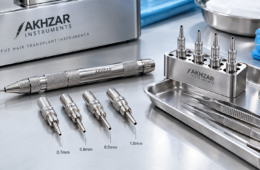
Common sizes may include 0.7 mm, 0.8 mm, 0.9 mm and 1.0 mm.
The appropriate size depends on the instrument, extraction approach and graft characteristics.
What Is a Sharp FUE Punch?
A sharp FUE punch has a defined cutting edge designed to penetrate and score tissue around the follicular unit.
The cutting edge is generally smooth rather than serrated.
Sharp punches are available in different diameters and can be manufactured for different extraction systems.
Important characteristics include:
- Edge consistency
- Diameter accuracy
- Alignment
- Manufacturing quality
- System compatibility
- Practitioner technique
Sharpness alone does not determine whether a punch is appropriate.
What Is a Serrated FUE Punch?
A serrated FUE punch contains small serrations along its cutting edge.
This changes how the edge interacts with tissue during the extraction process.
Serrated punches are also available in different diameters and configurations.
A serrated design should not automatically be considered better or worse than a sharp design. The appropriate choice depends on the extraction technique, follicular characteristics, instrument specifications and practitioner experience.
Sharp vs Serrated FUE Punch: Main Differences
| Feature | Sharp FUE Punch | Serrated FUE Punch |
|---|---|---|
| Cutting edge | Smooth cutting edge | Serrated cutting edge |
| Edge design | Continuous | Small serrations |
| Available sizes | Multiple diameters | Multiple diameters |
| Application | FUE graft harvesting | FUE graft harvesting |
| System compatibility | Depends on design | Depends on design |
| Selection | Technique and anatomy | Technique and anatomy |
The important point is that punch design is only one part of FUE extraction.
Is a Sharp FUE Punch Better Than a Serrated Punch?
There is no universal answer between Sharp vs serrated FUE punch. FUE is a minimally invasive hair restoration technique that involves harvesting individual follicular units.
A comparative study evaluating sharp, serrated and blunt punches reported differences in transection and graft yield under the conditions of that study. This demonstrates that punch design can be a meaningful technical variable.
However, research findings should not be interpreted as meaning that one design is automatically superior for every patient, donor area or practitioner.
Other factors can include:
- Hair angle
- Follicular anatomy
- Donor characteristics
- Punch diameter
- Punch alignment
- Depth
- Operator experience
That is why professional instrument selection requires a complete view rather than focusing on one feature.
Why Does Punch Diameter Matter?
Punch diameter is another important part of FUE instrument selection.
Commonly available sizes include:
0.7 mm | 0.8 mm | 0.9 mm | 1.0 mm
The smallest available punch is not automatically the correct choice.
Professionals need to consider the characteristics of the follicular unit, donor area and extraction technique.
Published research has also examined relationships between punch dimensions and tissue effects during FUE.
Hair Direction and Punch Alignment
Follicular orientation is an important part of FUE education.
The visible hair shaft can emerge from the scalp at an angle, while the follicular unit may have a different course underneath the skin.
The practitioner therefore needs to understand the natural direction of the follicular unit when positioning the punch.
Poor alignment can make extraction more difficult and may increase the possibility of follicular injury.
This is why a punch should always be considered together with anatomy and technique.
Sharpness and Instrument Condition
Instrument condition is another important consideration Sharp vs serrated FUE punch.
A punch that has lost its intended edge characteristics may interact differently with tissue.
Published literature has discussed punch sharpness and its relationship with extraction performance and graft transection.
For professional users, consistency, maintenance and appropriate replacement are therefore part of good instrument management.
Manual and Motorized FUE Punches
FUE punches can be used in manual or motorized systems depending on their design.
Manual systems rely on direct operator movement, while motorized systems use a powered handpiece to assist punch movement.
For more information, read:
How Should a Clinic Select an FUE Punch?
A practical selection process can include:
- Evaluate the follicular unit.
- Consider the donor area.
- Understand hair direction.
- Select an appropriate diameter.
- Compare sharp and serrated designs.
- Check system compatibility.
- Consider instrument quality.
- Match the instrument to professional technique.
Common Mistakes
Choosing only by price
Price is important, but professional users should also evaluate quality and suitability.
Assuming one size works for everyone
Follicular units vary between individuals and donor areas.
Assuming sharp is always better
Sharpness is only one instrument characteristic.
Ignoring follicular direction
Hair direction is important when considering punch positioning.
Ignoring system compatibility
The punch should be compatible with the intended extraction system.
Akhzar Instruments: Manufacturing + Education (Sharp vs serrated FUE punch)
Akhzar Instruments works as a professional hair transplant instrument manufacturer and supplier while also developing educational resources for the hair restoration community.
Our educational topics include:
- FUE punches
- Sharp and serrated punches
- Punch diameters
- Graft extraction
- Hair transplant forceps
- Sapphire blades
- Implanter instruments
- Graft handling
For international clinics, distributors and professional buyers, product supply can also involve wholesale, OEM and private-label requirements.
Frequently Asked Questions
What is the difference between a sharp and serrated FUE punch?
A sharp FUE punch generally has a smooth cutting edge, while a serrated FUE punch has small serrations along the cutting edge.
Is a sharp FUE punch better than a serrated punch?
Not universally. The appropriate choice depends on the procedure, graft characteristics, instrument design and practitioner technique.
What FUE punch sizes are available?
Common sizes include 0.7 mm, 0.8 mm, 0.9 mm and 1.0 mm, although availability varies between manufacturers.
Does punch diameter affect FUE extraction?
Punch diameter is one factor that can influence the extraction process. Selection should consider graft characteristics and professional technique.
Can sharp and serrated punches be used for manual FUE?
Sharp vs serrated FUE punch Depending on their design, both types can be manufactured for manual applications.
Can serrated punches be used with motorized systems?
Some serrated punches are designed for compatible motorized systems. Compatibility should be confirmed from the product specifications.
Can punch selection eliminate transection?
No. Transection can be influenced by multiple factors, including anatomy, alignment, depth and operator technique.
What should clinics consider when buying FUE punches?
Clinics can evaluate design, diameter, manufacturing consistency, compatibility, quantity, supplier reliability and OEM/private-label options.
Conclusion
Sharp and serrated FUE punches represent two different approaches to punch-edge design.
Neither should automatically be considered the universal choice.
The better approach is to understand: for Sharp vs serrated FUE punch
Punch Design + Diameter + Follicular Anatomy + Alignment + Technique
Akhzar Instruments aims to support this knowledge through professional hair transplant instruments and educational resources for the global hair restoration community.
- Follicular Unit Extraction for Hair Transplantation: An Update → PubMed PubMed research article
- Follicular Unit Extraction Hair Transplant → PMC Full-text FUE research at PMC
- Hair Transplantation and Follicular Unit Extraction → PubMed Hair transplantation review on PubMed
- Follicular unit extraction: minimally invasive surgery for hair transplantation → PubMed Original FUE research on PubMed
- Battle of the punches: Comparison of transection rates of different punches during FUE → PubMed Punch comparison study on PubMed
Comments (2)
How FUE Punch Design Affects Graft Extraction
[…] Fr More Info […]
How to Choose Hair Transplant Forceps
[…] Sharp vs Serrated FUE Punch […]