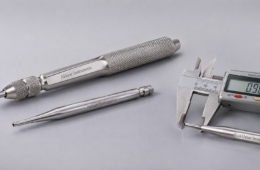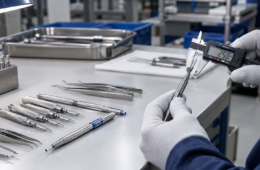
If your FUE punch not cutting cleanly, the problem may not simply be the punch diameter.
A FUE punch not cutting cleanly can be affected by several factors, including the condition of the cutting edge, punch design, diameter, alignment, insertion angle, depth control, tissue characteristics, or compatibility between the punch and the device being used.
A punch that performs well in one extraction workflow may not produce the same result in another.
This guide explains the main factors to review when an FUE punch does not appear to be cutting as cleanly as expected.
What Does “Not Cutting Cleanly” Mean in FUE?
In FUE, a circular hollow punch is used to dissect the follicular unit from the surrounding tissue before the graft is removed.
When an FUE punch is not cutting cleanly, several factors should be checked before changing the punch diameter.
When the punch is not performing as expected, a clinic may notice signs such as:
- Increased resistance during extraction
- More difficult graft dissection
- The punch requiring more force than usual
- Inconsistent penetration
- Grafts becoming more difficult to release
- Increased partial or complete transection
- More variability between extraction areas
- A noticeable difference between a new punch and an older punch
These signs should be evaluated as part of the complete extraction process rather than automatically attributed to one instrument characteristic.
Published reviews of FUE instrumentation describe multiple punch designs and devices, with different characteristics intended for different extraction situations. No single punch design is considered suitable for every case.
1. Check Whether the FUE Punch Has Become Dull
One of the first things to investigate is the condition of the cutting edge.
A sharp punch is designed to enter and dissect tissue efficiently. As the cutting edge becomes worn or damaged, its performance can change.
A dull or damaged punch may contribute to:
- Increased resistance
- Less consistent cutting
- More difficult dissection
- Increased manipulation
- Potential graft trauma
Published literature has specifically discussed punch sharpness as an important factor in FUE extraction and transection.
Alignment should also be reviewed when an FUE punch is not cutting cleanly, particularly when the problem occurs only in certain donor areas.
If a punch that previously performed well suddenly becomes difficult to use, compare its performance with a new, known-good punch of the same specification.
This can help determine whether the issue is related to the instrument rather than the overall extraction workflow.
Important: Don’t Assume Sharper Is Always Better
Punch performance is not determined by sharpness alone also when FUE punch is not cutting cleanly.
Different punch geometries and cutting-edge configurations have been developed because the relationship between the punch and follicular unit is more complicated than simply making the cutting edge sharper.
The objective is controlled follicular dissection with appropriate instrument selection for the established clinical technique.
2. Inspect the Punch Edge for Damage
A punch can lose performance without becoming obviously blunt and when FUE punch is not cutting cleanly.
Inspect the instrument for visible abnormalities such as:
- Damaged cutting edge
- Deformation
- Irregular tip
- Surface damage
- Contamination or residue
- Changes in the lumen
- Manufacturing defects
Even a small change at the tip can potentially affect how the punch interacts with tissue.
If an FUE punch is not cutting cleanly, review the following areas before changing multiple variables at once.
If multiple punches from the same batch show similar performance problems, it may also be worth reviewing the specification and manufacturing quality rather than replacing individual instruments one by one.
For professional clinical use, instruments should be inspected and maintained according to the manufacturer’s instructions and the clinic’s validated infection-control procedures.
3. Check the Punch Design
Two FUE punches can have the same diameter but behave differently.
FUE literature describes a variety of punch designs, including sharp, serrated, blunt, hybrid, flared and edge-out configurations.
Researchers have investigated different geometries because the position and behaviour of the cutting edge can influence how the punch interacts with the follicular unit.
For example, an edge-out punch has been designed with an internal bevel and thicker wall so that the cutting edge is positioned toward the outer diameter. Research describing this design reported a mechanism intended to reduce the likelihood of cutting follicles beneath the skin.
This does not mean that one punch design is universally superior.
For clinics looking for different FUE punch sizes and configurations, see our FUE Punches range.
Instead, the relevant question is:
Does the punch design suit the extraction workflow and follicular characteristics being encountered?
4. Review the Punch Diameter
Diameter is another important factor. FUE punch not cutting cleanly
Published FUE reviews describe punch diameters across a broad range, approximately 0.7 mm to 1.2 mm, with commonly used scalp sizes often around 0.9–1.0 mm. The appropriate choice depends on the extraction situation and clinical technique.
A smaller punch may reduce the size of the extraction opening, but it can also provide less clearance around some follicular units.
A larger punch may provide more clearance in certain situations, but it can remove more surrounding tissue.
Therefore, changing to a larger punch simply because the current punch is not cutting cleanly is not necessarily the correct solution.
First determine whether the issue is:
Diameter → edge condition → design → alignment → depth → technique
rather than assuming diameter is the only variable.
5. Check Alignment and Follicular Direction
The direction of the visible hair does not always perfectly represent the direction of the follicular unit beneath the skin.
Follicles can curve, change direction and vary in orientation.
Because of this, an instrument can appear to be entering along the visible hair direction while still not being optimally aligned with the follicular unit underneath.
If the punch seems to cut inconsistently in a particular donor area, the problem may therefore involve follicular orientation rather than a simple defect in the instrument.
Published FUE literature emphasizes the importance of individual follicular characteristics, hair emergence angle and extraction dynamics when selecting and using punches.
This is one reason why the same punch may perform differently across different patients or donor areas.
6. Consider Depth Control
Another factor is how deeply the punch is entering the tissue.
Too little penetration may leave the follicular unit insufficiently dissected, making subsequent removal more difficult.
Excessive penetration can increase the risk of damaging deeper structures and may contribute to follicular injury.
Reviews of FUE technique identify punch length and depth as factors that can influence transection and other extraction-related problems.
For that reason, depth should be controlled according to the established clinical technique rather than simply increasing penetration when the punch feels resistant.
If a clinic is experiencing repeated extraction problems, the appropriate response is to review the procedure with the qualified clinician responsible for the technique rather than treating greater force or depth as a universal solution.
7. Check the Punch and Device Compatibility
An FUE punch does not always work independently.
Depending on the system, the punch may be mounted on a manual handle or motorized handpiece.
The connection between the punch and the device can affect stability and performance.
Check:
- Correct punch size
- Correct mounting system
- Proper fit
- Device compatibility
- Secure attachment
- Appropriate manufacturer specifications
- Condition of the handle or handpiece
If a punch performs normally when used with one compatible system but poorly with another, the issue may not be the punch itself.
A complete instrument system should therefore be considered when troubleshooting extraction performance.
8. Don’t Ignore Tissue and Follicular Characteristics
Sometimes the instrument is not the main problem.
The donor area itself can influence extraction difficulty.
Factors that may vary include:
- Follicular angle
- Follicular curvature
- Hair calibre
- Follicular-unit structure
- Skin characteristics
- Fibrosis or previously treated areas
- Strength of tissue attachments
Recent clinical literature continues to describe how altered follicular angles and fibrotic tissue can make extraction more technically challenging.
This is particularly relevant when a punch works well in one donor area but becomes less predictable in another.
Therefore, a change in extraction performance does not automatically mean the punch has failed.
9. Compare a Problem Punch With a Known-Good Punch
A simple troubleshooting approach is to compare the suspected instrument with a new or known-good punch having the same specifications.
Ask:
Does the new punch perform differently?
If yes, the original instrument’s condition becomes a stronger possibility.
If no, investigate other variables such as:
- Punch design
- Diameter
- Device compatibility
- Donor-area characteristics
- Alignment
- Depth control
- Extraction technique
This type of comparison is more useful than changing several variables at the same time.
If you change the diameter, punch type, device and technique simultaneously, it becomes difficult to identify what actually caused the change.
Sharp vs Serrated FUE Punch
Sharp and serrated punches are both used in FUE, but they are not interchangeable in every situation.
A sharp punch has a continuous cutting edge and is designed for cutting tissue.
A serrated punch has a different edge configuration intended to interact with tissue differently.
Research comparing punch types has reported differences in graft yield and transection rates, but these results should not be interpreted as meaning that one punch type is universally best for every patient or technique.
The appropriate selection depends on the surgeon’s experience, extraction method, follicular characteristics and the specific clinical situation.
Therefore, if an FUE punch is not cutting cleanly, switching from sharp to serrated—or vice versa—should be considered as part of a broader instrument assessment rather than as an automatic fix.
FUE Punch Not Cutting Cleanly: Troubleshooting Checklist
Before changing the entire extraction setup, review these areas:
Punch Condition
- Is the cutting edge intact?
- Is the punch visibly damaged?
- Has its performance changed over time?
- Does a new punch of the same specification perform differently?
Punch Specification
- Is the diameter appropriate for the established technique?
- Is the punch design suitable?
- Is the configuration correct?
- Is the punch compatible with the intended device?
Extraction Factors
- Are follicular units unusually angled or curved?
- Is the donor area fibrotic or previously treated?
- Is the established depth-control method being followed?
- Is unnecessary force being introduced because of resistance?
Device
- Is the punch securely mounted?
- Is the handle or handpiece functioning correctly?
- Is the punch compatible with the system?
- Does the problem occur with multiple compatible punches?
This checklist can help separate an instrument problem from an extraction workflow problem.
When Should You Replace an FUE Punch?
A punch should not be kept in service simply because it still physically looks usable.
If the cutting performance has changed, the edge is damaged, the punch is deformed, or the instrument no longer performs according to its intended specification, replacement may be appropriate.
The decision should follow the manufacturer’s instructions and the clinic’s instrument-control procedures.
Avoid treating improvised sharpening or modification as a universal solution. A surgical instrument’s geometry and cutting characteristics are part of its design, so unauthorized modification can change performance and may introduce additional risks.
For professional use, replacement with a properly specified instrument is often easier to validate than an instrument that has been modified outside the manufacturer’s process.
How to Choose an FUE Punch for Your Clinic
There is no single punch that is ideal for every extraction situation.
A clinic evaluating FUE punches should consider:
1. Diameter
What sizes are required for the clinic’s established workflow?
2. Edge configuration
Does the clinic use sharp, serrated or another punch configuration?
3. Design
Is a conventional, hybrid, flared or other geometry required?
4. Device compatibility
Will the punch work with the existing manual or motorized system?
5. Consistency
Are the instruments manufactured to consistent specifications?
6. Availability
Can the required sizes and configurations be supplied consistently?
7. Custom requirements
Does the manufacturer support OEM or private-label requirements?
The goal is not simply to find the “sharpest” punch.
The goal is to select an instrument that matches the clinical workflow and required specifications.
FUE Punch Options From Akhzar Instruments
At Akhzar Instruments, we manufacture and export hair transplant and surgical instruments from Sialkot, Pakistan.
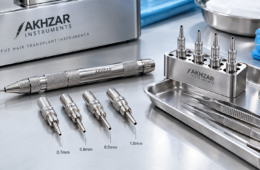
Our FUE punch options can include:
- 0.7 mm
- 0.8 mm
- 0.9 mm
- 1.0 mm
- Sharp configurations
- Serrated configurations
- Manual punch options
- Other configurations based on customer requirements
If your clinic, distributor or medical business already has a specific punch specification, you can send us the requirements instead of selecting from a generic one-size-fits-all list.
We can review the required:
Size + punch type + quantity + specification
and prepare a custom quotation.
For buyers who require their own branding, OEM and private-label options are also available.
Frequently Asked Questions
Why is my FUE punch not cutting cleanly?
Possible causes include a worn or damaged cutting edge, unsuitable punch design, diameter mismatch, device compatibility issues, follicular orientation, depth-control problems or changes in the donor tissue. The specific cause needs to be evaluated within the clinical workflow.
Can a dull FUE punch increase graft damage?
A loss of sharpness can change cutting performance and may contribute to more difficult extraction. Published literature has identified punch sharpness as an important factor in FUE harvesting.
Is a sharp FUE punch always better?
No. Punch performance depends on more than sharpness. Different punch designs have been developed to address different extraction dynamics and follicular characteristics.
What FUE punch sizes are available?
FUE punches are manufactured in multiple diameters. Commonly used scalp sizes described in the literature include approximately 0.9 mm and 1.0 mm, while smaller sizes are also available. Akhzar Instruments can supply options including 0.7 mm, 0.8 mm, 0.9 mm and 1.0 mm depending on the required specification.
Should I use a larger punch if my current punch is not cutting well?
Not automatically. A larger diameter changes the relationship between the punch and surrounding tissue and may have other consequences. First determine whether the actual problem is edge condition, punch design, alignment, depth, device compatibility or another factor.
When should an FUE punch be replaced?
Replacement should be considered when the punch is damaged, deformed, excessively worn or no longer performs according to its intended specification. Follow the manufacturer’s instructions and your clinic’s validated instrument-control procedures.
Final Takeaway
When an FUE punch is not cutting cleanly, changing the punch size is not always the answer.
Start by checking the complete system:
Punch condition → edge design → diameter → alignment → depth → device compatibility → follicular characteristics
A properly selected FUE punch should be considered as part of the overall extraction workflow rather than as an isolated instrument.
If your clinic needs specific FUE punch sizes, sharp or serrated configurations, manual options, OEM or private-label instruments, send Akhzar Instruments your requirements.
We can review the specification and prepare a custom quotation based on your requirements.
Akhzar Instruments
Sialkot, Pakistan
Hair Transplant & Surgical Instruments Manufacturer & Exporter
OEM / Private Label Available